

Water-Sight: optical monitoring of water colour and clarity
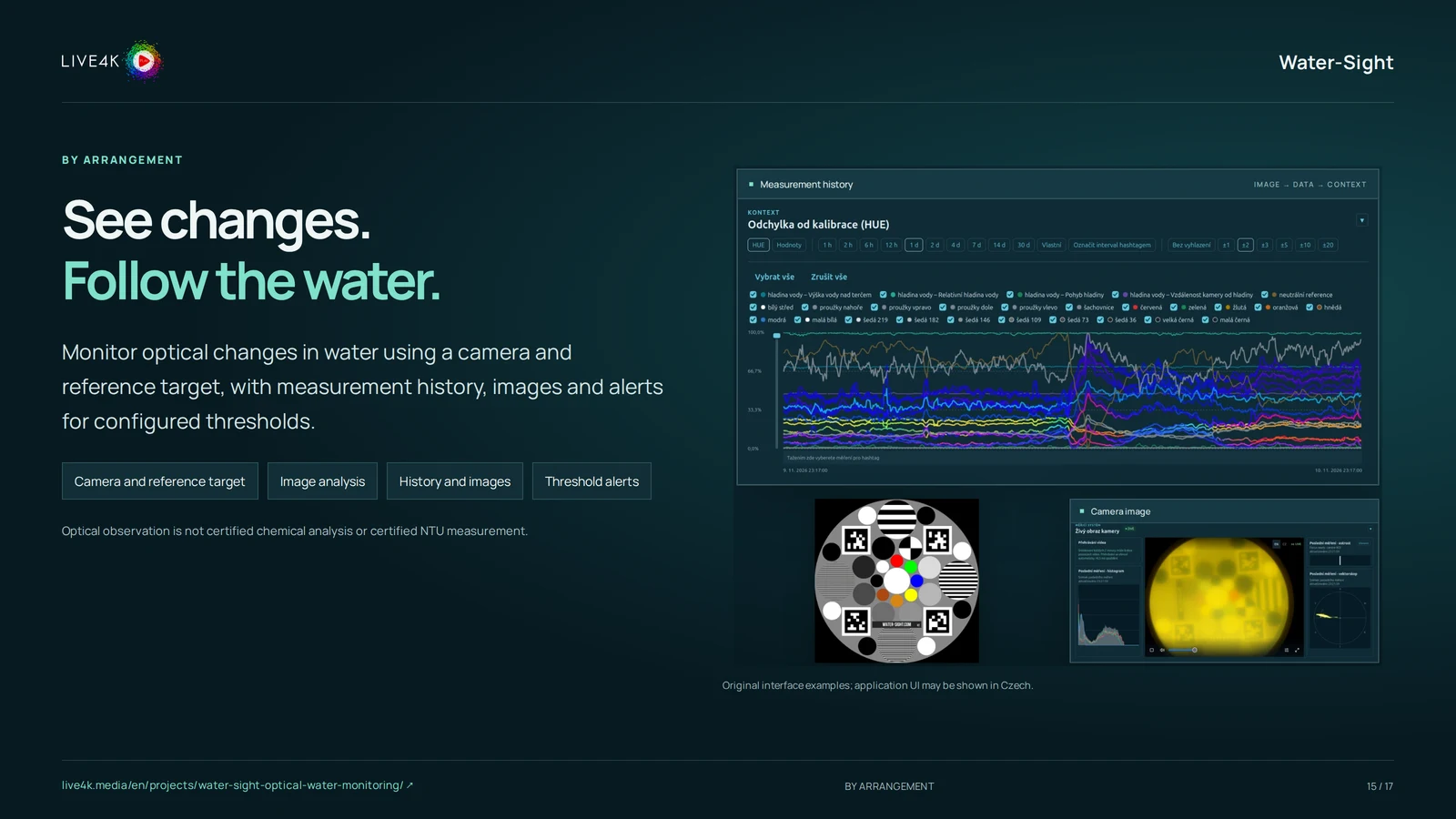
Monitor optical changes in water using a camera and reference target, with measurement history, images and alerts for configured thresholds.
PURPOSE AND VALUE
Water-Sight: purpose and audience.
Water-Sight observes water against a reference target and tracks changes in its optical appearance. A camera node and image analysis connect the physical observation to a history and an agreed alerting workflow.
A time series of images can reveal changes that are difficult to assess from occasional visual checks. Recording the observation and its trend provides useful context for a human operator.
Who it is for
- Operators who need to observe changes in water appearance
- Teams assessing optical monitoring at a specific installation
- Businesses connecting physical monitoring with data workflows
When it is useful
When changes in colour or clarity are operationally relevant and you want a documented optical trend rather than an occasional visual impression.
Where it works
At a suitable water observation point whose lighting, target placement, water conditions and installation constraints have been assessed. Local operation without internet is possible in the agreed setup.
CAPABILITIES
What the solution can do.
Camera and reference target
Observe the water against a known visual reference.
Based on the project presentation; we will confirm the specific scope.Image analysis
Track defined optical changes within the configured setup.
Based on the project presentation; we will confirm the specific scope.History and images
Review the development of observations over time.
Based on the project presentation; we will confirm the specific scope.Threshold alerts
Notify the agreed workflow when configured limits are crossed.
Based on the project presentation; we will confirm the specific scope.USE CASES
How it could help in practice.
Example situations the solution can support. We define the specific scope and expected value around your requirements.
Plant operators
See when the appearance of water changes
Track a defined observation point with images and a time history.
Expected benefitMore context than an occasional manual look.
Technical teams
Assess a location for optical monitoring
Run a scoped installation evaluation and compare the observations with actual conditions.
Expected benefitA basis for deciding whether the method fits the site.
FROM INPUTS TO OUTCOMES
How it works.
Water-Sight observes water against a reference target and tracks changes in its optical appearance. A camera node and image analysis connect the physical observation to a history and an agreed alerting workflow.
- 01
Assess the observation point
Check the purpose, installation conditions and relevant changes.
- 02
Set up the reference and camera
Prepare a stable observation arrangement and the operating environment.
- 03
Establish the observation workflow
Configure capture, history and appropriate thresholds.
- 04
Validate in place
Compare behaviour with the actual conditions and agree operator responsibilities.
Inputs, outputs and components
What goes in
Project brief
An appropriate observation point and description of relevant changes This input is needed for delivery.
Requirements and responsibilities
Access, suitable installation conditions and a person responsible for interpreting alerts This input is needed for delivery.
What comes out
Agreed outcome
Optical observations, images and history in the agreed setup
As specified in the project agreement.
Handover
Configured alerts and operating guidance within scope
As specified in the project agreement.
Components
Camera and reference target
Observe the water against a known visual reference.
Image analysis
Track defined optical changes within the configured setup.
History and images
Review the development of observations over time.
Threshold alerts
Notify the agreed workflow when configured limits are crossed.
CONNECTIONS AND FORMATS
How it fits your environment.
Monitoring and alerting workflowProposed connection
Agree the available interface, destination and response process for the installation.
Connection requirements
- Confirm the actual interface, permissions and scope before implementation.
What needs a separate agreement
- Compatibility with every third-party system is not implied.
PREPARATION AND HANDOVER
What we need to agree.
Start with a short conversation about your intended outcome, the existing environment and a useful first scope.
What we need from you
- An appropriate observation point and description of relevant changes
- Access, suitable installation conditions and a person responsible for interpreting alerts
Prerequisites
- An appropriate observation point and description of relevant changes
- Access, suitable installation conditions and a person responsible for interpreting alerts
What our team provides
- Optical observations, images and history in the agreed setup
- Configured alerts and operating guidance within scope
What we check at handover
- Review the agreed functions and deliverables against the project brief.
- Confirm relevant interfaces, responsibilities and limitations.
Engagement model and delivery scope
Ways to work together
- Project scope agreed individually.
Operating model
- Operating model and responsibilities agreed for the actual use case.
What affects the scope
- Optical observation is not certified chemical analysis or certified NTU measurement.
- Colour and clarity readings must not be presented as a universal water-quality or safety certificate.
- Lighting, fouling, installation and actual site conditions affect the result.
Questions for the first conversation
- What outcome should the project support?
- What environment and constraints apply?
- Who will review the result and manage its use?
Scope, availability and conditions
- Optical observation is not certified chemical analysis or certified NTU measurement.
- Colour and clarity readings must not be presented as a universal water-quality or safety certificate.
- Lighting, fouling, installation and actual site conditions affect the result.
What is not automatically included
- Optical observation is not certified chemical analysis or certified NTU measurement.
- Colour and clarity readings must not be presented as a universal water-quality or safety certificate.
- Lighting, fouling, installation and actual site conditions affect the result.
FREQUENTLY ASKED QUESTIONS
Questions you may have.
Does Water-Sight certify that water is safe?
No. It observes optical changes and does not replace certified chemical testing or a safety assessment.
Does it measure certified turbidity in NTU?
That is not established. The described method is optical observation with a reference target and site-specific interpretation.
LET’S TALK
Let’s discuss working together.
Choose a time for a short call. We will start with this project and discuss your needs, constraints and next steps.
We will agree the specific scope and delivery options around your requirements.
The call booking form is loading. If it does not load, email us or call +420 773 749 040.