

Network and server management, Linux and private cloud
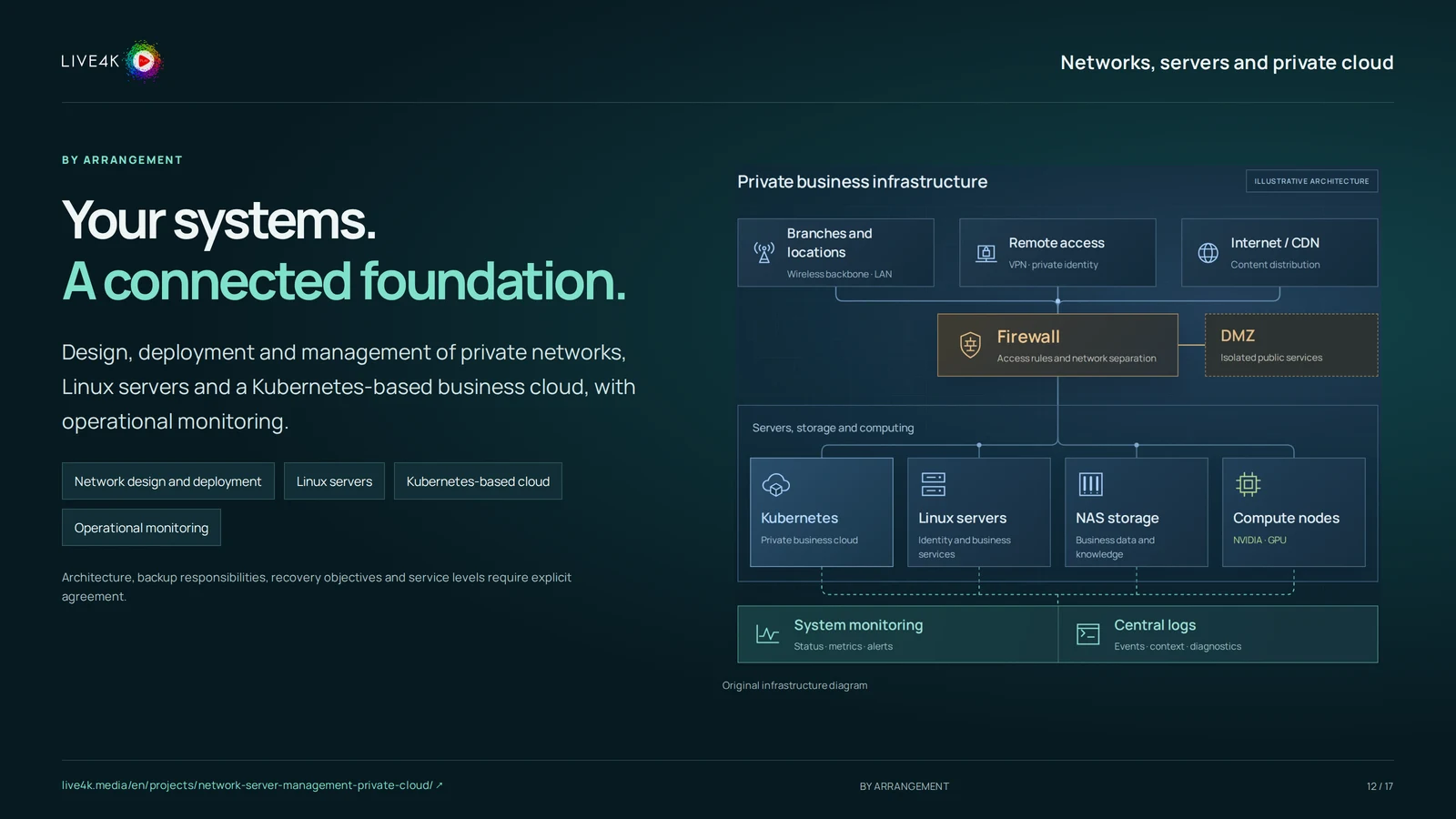
Design, deployment and management of private networks, Linux servers and a Kubernetes-based business cloud, with operational monitoring.
PURPOSE AND VALUE
Networks, servers and private cloud: purpose and audience.
We prepare the infrastructure that business applications and data need. Networks, Linux servers and Kubernetes are considered as parts of one operating environment with defined management responsibilities.
Applications depend on the systems around them. Designing connectivity, hosting and operational oversight together helps avoid gaps between deployment and everyday use.
Who it is for
- Businesses running their own applications
- Teams with private server or cloud requirements
- Organisations connecting sites, services and operational responsibilities
When it is useful
When you are building or changing infrastructure, deploying an application or clarifying who manages the systems it relies on.
Where it works
In the agreed company, server or hosting environment. On-site installation and remote management depend on the project.
CAPABILITIES
What the solution can do.
Network design and deployment
Prepare connectivity around the actual sites, users and applications.
Based on the project presentation; we will confirm the specific scope.Linux servers
Set up and manage agreed Linux-based services and their operating environment.
Based on the project presentation; we will confirm the specific scope.Kubernetes-based cloud
Design a private application platform where this operating model fits the requirements.
Based on the project presentation; we will confirm the specific scope.Operational monitoring
Include visibility into agreed services as part of the management scope.
Based on the project presentation; we will confirm the specific scope.USE CASES
How it could help in practice.
Example situations the solution can support. We define the specific scope and expected value around your requirements.
Application owners
Prepare a place to run a business system
Design hosting and network dependencies alongside the application.
Expected benefitA more complete route from development to operation.
Growing businesses
Bring server management into a coherent plan
Define the environment, monitoring and responsibility for maintenance.
Expected benefitClearer ownership of everyday operation.
FROM INPUTS TO OUTCOMES
How it works.
We prepare the infrastructure that business applications and data need. Networks, Linux servers and Kubernetes are considered as parts of one operating environment with defined management responsibilities.
- 01
Map the dependencies
Identify sites, applications, data and operational needs.
- 02
Design the environment
Agree architecture, access, responsibilities and implementation steps.
- 03
Deploy and verify
Check connectivity and the required service functions.
- 04
Agree ongoing management
Define monitoring, maintenance and the response process.
Inputs, outputs and components
What goes in
Project brief
Current infrastructure information and application requirements This input is needed for delivery.
Requirements and responsibilities
Authorised access, change ownership and agreed operating constraints This input is needed for delivery.
What comes out
Agreed outcome
The agreed network, server or cloud environment
As specified in the project agreement.
Handover
Management and monitoring arrangements defined in the project
As specified in the project agreement.
Components
Network design and deployment
Prepare connectivity around the actual sites, users and applications.
Linux servers
Set up and manage agreed Linux-based services and their operating environment.
Kubernetes-based cloud
Design a private application platform where this operating model fits the requirements.
Operational monitoring
Include visibility into agreed services as part of the management scope.
CONNECTIONS AND FORMATS
How it fits your environment.
Business applicationsProposed connection
Match hosting, connectivity and access requirements to the actual application.
Connection requirements
- Confirm the actual interface, permissions and scope before implementation.
What needs a separate agreement
- Compatibility with every third-party system is not implied.
Existing infrastructureProposed connection
Assess compatibility, dependencies and the transition plan before changes.
Connection requirements
- Confirm the actual interface, permissions and scope before implementation.
What needs a separate agreement
- Compatibility with every third-party system is not implied.
PREPARATION AND HANDOVER
What we need to agree.
Start with a short conversation about your intended outcome, the existing environment and a useful first scope.
What we need from you
- Current infrastructure information and application requirements
- Authorised access, change ownership and agreed operating constraints
Prerequisites
- Current infrastructure information and application requirements
- Authorised access, change ownership and agreed operating constraints
What our team provides
- The agreed network, server or cloud environment
- Management and monitoring arrangements defined in the project
What we check at handover
- Review the agreed functions and deliverables against the project brief.
- Confirm relevant interfaces, responsibilities and limitations.
Engagement model and delivery scope
Ways to work together
- Project scope agreed individually.
Operating model
- Operating model and responsibilities agreed for the actual use case.
What affects the scope
- Architecture, backup responsibilities, recovery objectives and service levels require explicit agreement.
- Kubernetes is an option for suitable workloads, not a requirement for every business.
- No universal uptime, capacity or security certification is implied.
Questions for the first conversation
- What outcome should the project support?
- What environment and constraints apply?
- Who will review the result and manage its use?
Scope, availability and conditions
- Architecture, backup responsibilities, recovery objectives and service levels require explicit agreement.
- Kubernetes is an option for suitable workloads, not a requirement for every business.
- No universal uptime, capacity or security certification is implied.
What is not automatically included
- Architecture, backup responsibilities, recovery objectives and service levels require explicit agreement.
- Kubernetes is an option for suitable workloads, not a requirement for every business.
- No universal uptime, capacity or security certification is implied.
FREQUENTLY ASKED QUESTIONS
Questions you may have.
Do we need Kubernetes?
That depends on your workloads and operating requirements. We assess the fit rather than assume one platform suits every project.
What does management include?
The managed services, monitoring, access, maintenance and response responsibilities are defined for your environment.
LET’S TALK
Let’s discuss working together.
Choose a time for a short call. We will start with this project and discuss your needs, constraints and next steps.
We will agree the specific scope and delivery options around your requirements.
The call booking form is loading. If it does not load, email us or call +420 773 749 040.