
LIVE4K STREAM: live video streaming and distribution
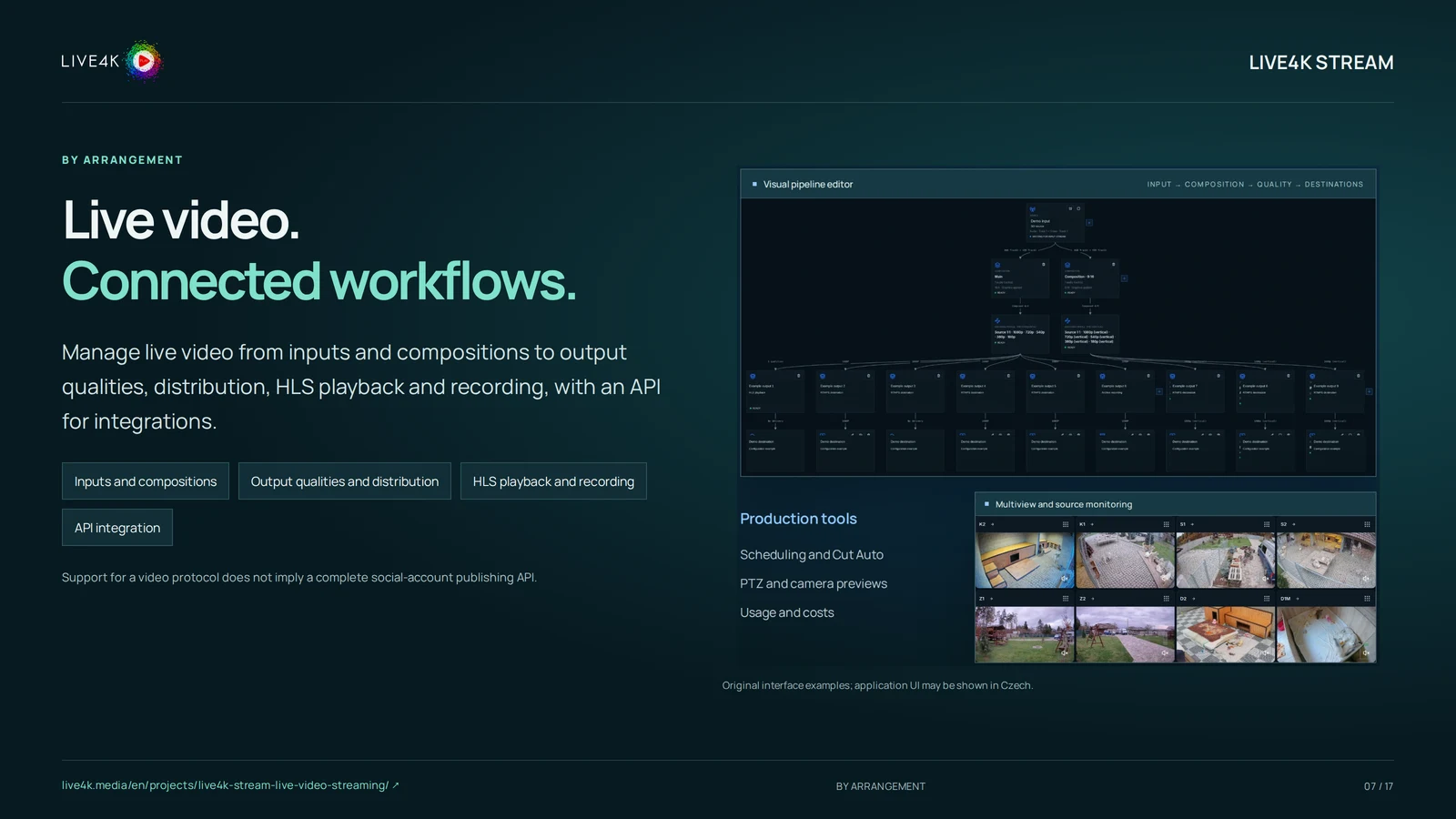
Manage live video from inputs and compositions to output qualities, distribution, HLS playback and recording, with an API for integrations.
PURPOSE AND VALUE
LIVE4K STREAM: purpose and audience.
LIVE4K STREAM connects video sources, processing and outputs in a controlled streaming workflow. It supports preparing compositions and output variants and connecting them to playback, distribution and recording as required.
Live video often crosses several systems and network boundaries. A coordinated workflow and API make it easier to treat signal routing and distribution as part of a wider production or business process.
Who it is for
- Event and broadcast producers
- Companies with internal or external live video
- Software teams integrating live video workflows
When it is useful
When you need to coordinate several inputs, output variants, playback or recording rather than send one isolated feed.
Where it works
Streaming infrastructure connected to the production environment and agreed distribution destinations. Available connectivity must be checked.
CAPABILITIES
What the solution can do.
Inputs and compositions
Bring sources into a workflow and prepare the required picture compositions.
Based on the project presentation; we will confirm the specific scope.Output qualities and distribution
Prepare agreed quality variants and route them to supported destinations.
Based on the project presentation; we will confirm the specific scope.HLS playback and recording
Connect the output to HLS playback and preserve recordings within the agreed setup.
Based on the project presentation; we will confirm the specific scope.API integration
Connect supported control functions to other applications and processes.
Based on the project presentation; we will confirm the specific scope.USE CASES
How it could help in practice.
Example situations the solution can support. We define the specific scope and expected value around your requirements.
Event producers
Distribute one production to several destinations
Plan sources, compositions and output variants together.
Expected benefitA clearer and more manageable distribution workflow.
Business application teams
Control live video from another system
Connect agreed API operations to the application workflow.
Expected benefitLess disconnected manual coordination.
FROM INPUTS TO OUTCOMES
How it works.
LIVE4K STREAM connects video sources, processing and outputs in a controlled streaming workflow. It supports preparing compositions and output variants and connecting them to playback, distribution and recording as required.
- 01
Define the signal plan
Identify sources, audiences, output qualities and destinations.
- 02
Prepare the workflow
Configure the agreed processing, compositions and routes.
- 03
Test end to end
Verify sources, network paths, playback and recording under the intended conditions.
- 04
Operate and review
Run the transmission and hand over the agreed outputs and operating responsibilities.
Inputs, outputs and components
What goes in
Project brief
Source formats, destinations, expected audience and access requirements This input is needed for delivery.
Requirements and responsibilities
Suitable connectivity and agreement on operation and support This input is needed for delivery.
What comes out
Agreed outcome
Configured live video outputs and playback within scope
As specified in the project agreement.
Handover
Agreed recordings and integration interfaces
As specified in the project agreement.
Components
Inputs and compositions
Bring sources into a workflow and prepare the required picture compositions.
Output qualities and distribution
Prepare agreed quality variants and route them to supported destinations.
HLS playback and recording
Connect the output to HLS playback and preserve recordings within the agreed setup.
API integration
Connect supported control functions to other applications and processes.
CONNECTIONS AND FORMATS
How it fits your environment.
Live video protocolsProposed connection
Protocol compatibility is checked against the source and destination; it is separate from access to a social platform account.
Connection requirements
- Confirm the actual interface, permissions and scope before implementation.
What needs a separate agreement
- Compatibility with every third-party system is not implied.
Custom API workflowsProposed connection
Use supported endpoints to connect stream control to the agreed business or production application.
Connection requirements
- Confirm the actual interface, permissions and scope before implementation.
What needs a separate agreement
- Compatibility with every third-party system is not implied.
PREPARATION AND HANDOVER
What we need to agree.
Start with a short conversation about your intended outcome, the existing environment and a useful first scope.
What we need from you
- Source formats, destinations, expected audience and access requirements
- Suitable connectivity and agreement on operation and support
Prerequisites
- Source formats, destinations, expected audience and access requirements
- Suitable connectivity and agreement on operation and support
What our team provides
- Configured live video outputs and playback within scope
- Agreed recordings and integration interfaces
What we check at handover
- Review the agreed functions and deliverables against the project brief.
- Confirm relevant interfaces, responsibilities and limitations.
Engagement model and delivery scope
Ways to work together
- Project scope agreed individually.
Operating model
- Operating model and responsibilities agreed for the actual use case.
What affects the scope
- Support for a video protocol does not imply a complete social-account publishing API.
- Bitrates, latency, viewer capacity and network resilience require a concrete design.
- Availability and access control are agreed for each deployment; no universal SLA is implied.
Questions for the first conversation
- What outcome should the project support?
- What environment and constraints apply?
- Who will review the result and manage its use?
Scope, availability and conditions
- Support for a video protocol does not imply a complete social-account publishing API.
- Bitrates, latency, viewer capacity and network resilience require a concrete design.
- Availability and access control are agreed for each deployment; no universal SLA is implied.
What is not automatically included
- Support for a video protocol does not imply a complete social-account publishing API.
- Bitrates, latency, viewer capacity and network resilience require a concrete design.
- Availability and access control are agreed for each deployment; no universal SLA is implied.
FREQUENTLY ASKED QUESTIONS
Questions you may have.
Does protocol support mean automatic publishing to every social account?
No. Transport compatibility, account permissions and platform APIs are separate matters and must be checked.
Can our software control the stream?
The platform has an API. We agree the supported operations, authentication and integration scope for your system.
LET’S TALK
Let’s discuss working together.
Choose a time for a short call. We will start with this project and discuss your needs, constraints and next steps.
We will agree the specific scope and delivery options around your requirements.
The call booking form is loading. If it does not load, email us or call +420 773 749 040.